YU Training & Coaching shares and translates practical professional experience and enables participants to improve their performance and achieve their goals.


TRAINING & COACHING
Training

Standard trainings can be delivered to small and large groups in 1-3 hrs training sessions as separate modules or combined in training programs.
Selected Training Modules:

Effective and Sustainable Strategies
The training provides an introduction to the essence and basic principles of strategy tools and the strategy developing process. The participants learn to set their goals, the need and tools to identify or develop Unique Selling Points (the Why You) and strategic options, and the role of risk management for strategies.

What’s a Business Innovation?
For commercialisation activities and engagements with industry partners, it is crucial to understand that customers and companies are seeking a solution to an unmet need rather than a novelty or a research outcome. The training outlines the principles of a Business Innovation, the often-required interdisciplinary approach, and the dependency of the success on time, location, the environment and an economy of scale. Participants will learn about approaches and tools to develop and offer a business innovation.

The 360 Leadership Approach
360 Leadership describes the need in flat and agile organisations to be a leader not only for your team but leading your colleagues horizontally and leading your line manager. The training differentiates Leaders and Managers and leadership styles, shares good leadership principles from own experience and highlights the importance of communication as a leadership tool.

How to use your time wisely
Good time management requires an understanding of the difference between effectiveness and efficiency, evidence based prioritisation, strategic decision making and effective delegation skills. The training provides management tools and practical recommendations that can easily and immediately be applied into work routines.

Establishing sustainable partnerships with mutual benefits
Participants will learn how to engage and create sustainable collaboration with mutual benefits for both sides. Crucial elements are to understand intention and expectation of both parties, understand the sector landscape (market analysis), identify and assess potential partners (portfolio analysis), find joint a mission and goals (goal setting), define the roles of the partners (collaboration model), the options to approach them (access management) and learn about success factors for sustainable collaborations (operating and governance model).
Selected Training Programs:

The expected outcomes are that the participating HDR students will learn management skills that will enhance their career progressions independent if they follow an academic or industry career pathway. The participants learn about critical aspects of developing and implementing “Why You” strategies, the importance and of leadership, how to make most of their limited time and how innovation is defined in a commercial environment.
Other topics could be included on demand.

The expected outcomes are improved supervisor skills of the participants which will enable them to lead their research groups and to provide excellent supervision and leadership to their HDR students. This will lead to a better training and experience for HDR students and enhance their job readiness and employability. In addition, the program will contribute to the academic development of the supervisors more generally and improve the performance of the research group overall. The supervisors will hear about how their leadership is crucial for their HDR students, learn strategy basics and how to ensure they have sufficient time for their supervisor tasks.
The program could be combined with individual coaching.
Training can be tailored to demand and needs. Contact us to jointly develop the best training concept together.
Training plus Coaching
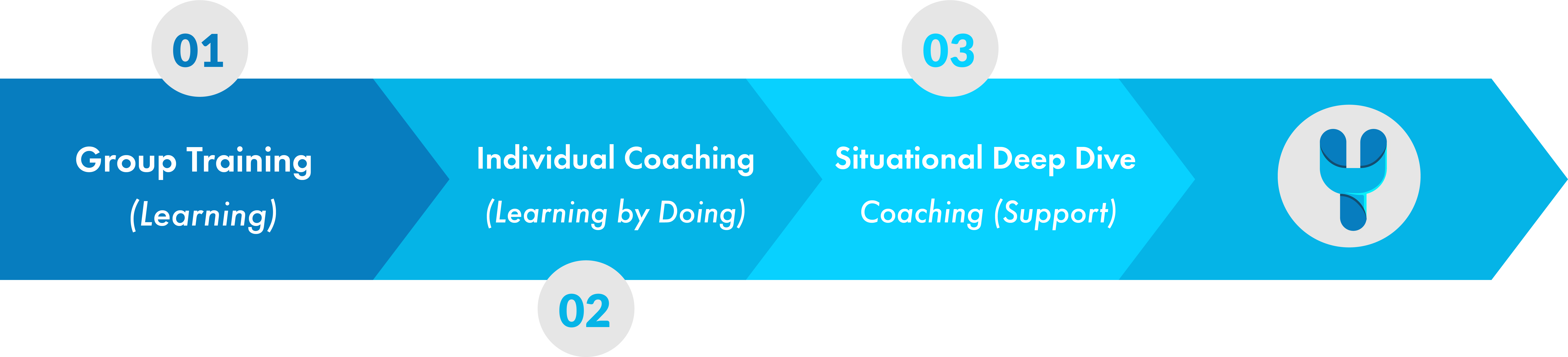
The combination of small group training (learning) combined with individual coaching (learning by doing) ensures the highest translation level from learned skills to individual day to day needs. It is recommended to offer complementary situational deep dive coaching on demand to support participants in critical situations.
Selected Programs:

The expected outcomes are that the participants are enabled to build their academic identity and develop a research strategy to progress their career in the highly competitive academic ecosystem by following translated and adapted “Why You” approaches from other competitive sectors. In the learning-by-doing session they are supported to apply the new perspectives to their current research environment and their academic personalities. As Early-Career Researchers are specifically time poor, the participants hear about practical tips for their time management.

The expected outcomes are that the participants will enhance their leadership and management skills by an executive education program adapted to the academic ecosystem and demonstrate these new skills in their emerging role as academic leaders in their and across other disciplines. The participants learn about the development and implementation of institutional “Why You’ strategies and underlying operational frameworks, improve their 360 leadership skills required for academic management roles, and how to optimise their time management when it comes to have dual responsibilities as an institutional and research group leader. The individual learning-by-doing sessions play a crucial role for the program as the emerging leaders are exposed to new challenges.

The expected outcome of the program is that academics are enabled to develop their industry engagement strategy and approach to identified enterprises with the aim to create impact and commercialise their research outcomes through engagement with external stakeholders and markets. The participants learn about the definition and needs of an innovation in the commercial sector and how to evolve their academic outcomes in market ready solutions, the importance and how to develop a unique selling proposition – the Why You – as crucial element for any commercialisation strategies and receive practical tips about how the identify, approach and work with industry partners.
Coaching
YU provides coaching as the combination of training and mentoring for individual senior academics and Early- and Mid-Career Researchers (EMCRs) who have participated in one of the YU Training & Coaching Programs.
The evidence based coaching program is focussed on advice for day-to day tasks of academic leaders and the development of strategies to define individual success factors and their academic unit. Coachees develop strategic and operational management as well as 360 leadership skills to achieve and exploit them.